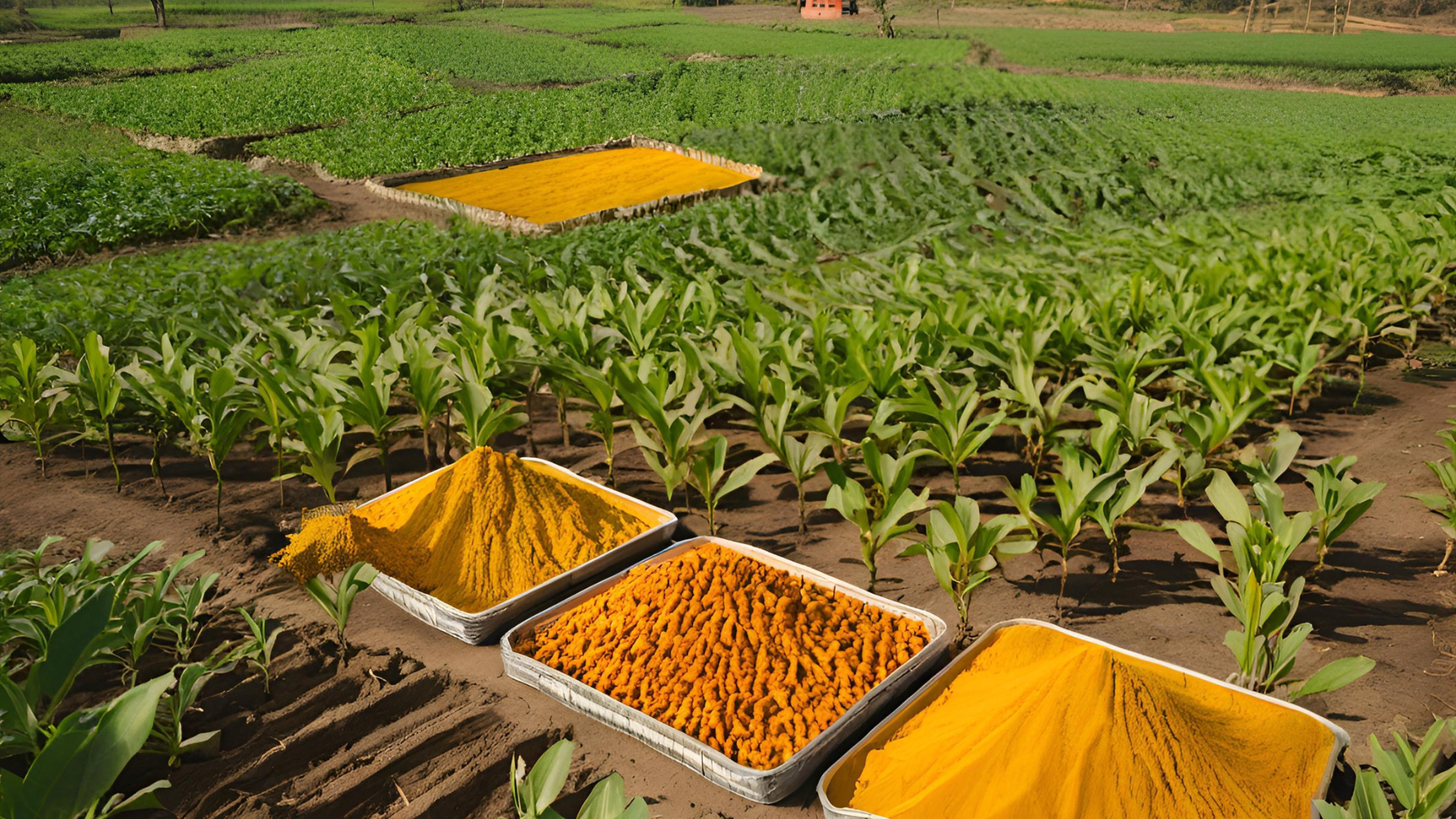
Whole Turmeric vs. Curcumin – The Truth the World Needs to Know
For centuries, turmeric has been an important part of Indian food, Ayurveda, and traditional wellness practices. The golden root, known as Curcuma longa, has been valued not only for its colour and flavour but also for its complex natural composition.
However, modern supplements often focus heavily on one compound: curcumin. You may have seen products marketed as “95% curcumin” or “high-curcumin turmeric extract.” But is concentrating on one compound the same as consuming the whole turmeric root?
The answer is more nuanced.
Turmeric Is More Than Curcumin
Curcumin is one of the best-studied compounds found in turmeric. It belongs to a group of natural compounds called curcuminoids and has been investigated for antioxidant and anti-inflammatory activity. However, turmeric is not made up of curcumin alone.
The whole turmeric rhizome naturally contains several groups of compounds, including:
Curcuminoids – including curcumin and related compounds.
Turmerones and other essential-oil compounds – naturally occurring aromatic compounds found in turmeric.
Polysaccharides – complex carbohydrates naturally present in the rhizome.
Volatile oils and other phytochemicals – contributing to turmeric’s characteristic aroma and biological activity.
Naturally occurring nutrients and minerals – present in varying amounts depending on soil, cultivation and processing.
Scientific research continues to explore how these compounds interact with one another. For example, studies of turmeric essential oils have identified turmerones as major constituents, while research into curcumin has also highlighted its naturally limited oral bioavailability.
Whole Turmeric and Curcumin Are Not the Same Thing
A concentrated curcumin extract is designed to increase the proportion of particular compounds. Whole turmeric, on the other hand, retains a much broader spectrum of compounds naturally found in the rhizome.
Therefore, the comparison should not simply be “good turmeric versus bad curcumin.”
Instead, it is about understanding the difference between a complete botanical ingredient and an isolated or concentrated compound.
Curcumin has genuine scientific value. At the same time, it does not represent every compound naturally present in turmeric.
This distinction matters because the biological activity of a plant cannot always be understood by looking at one molecule alone.
What Does Science Say About Curcumin?
Curcumin has been extensively studied. Research has explored its potential antioxidant and anti-inflammatory effects, as well as its possible role in several areas of human health.
However, there is an important limitation: curcumin has relatively poor oral bioavailability. In simple terms, the body does not absorb and retain large amounts of conventional curcumin efficiently. Researchers have therefore developed different formulations and combinations intended to improve absorption.
This is one reason why “95% curcumin” should not automatically be interpreted as “95% more effective.”
A higher percentage of one compound tells you about concentration, not necessarily the overall value of the complete turmeric root.
Why Whole Turmeric Deserves Attention
Whole turmeric offers something different: chemical diversity.
Instead of removing most of the naturally occurring compounds and concentrating primarily on curcuminoids, whole-root preparations can preserve a wider range of turmeric’s native constituents.
Research on turmeric essential oils, for instance, has identified turmerones and other volatile compounds with biological activity. Researchers are also investigating whether interactions between turmeric’s different constituents may contribute to its overall effects.
Nevertheless, more high-quality human research is needed to determine exactly how whole-turmeric preparations compare with specific curcumin formulations for different health outcomes.
That is an important distinction. Traditional use can guide interest and research, but it should not be presented as proof of a medical treatment.
Whole Turmeric vs. Curcumin Extract
| Whole Turmeric | Curcumin Extract |
|---|---|
| Contains a broader range of natural turmeric compounds | Concentrates specific curcuminoids |
| Retains more of the original botanical matrix | Focuses on selected compounds |
| Traditionally used as a whole food and Ayurvedic ingredient | Primarily developed as a concentrated supplement |
| Composition can vary naturally | Designed for more controlled concentration |
| Represents the complete turmeric rhizome | Represents a selected fraction of turmeric |
Neither approach should automatically be labelled “best” for every person or every purpose. The right choice depends on the product, formulation, dose, quality and intended use.
The Importance of Quality and Transparency
Whether you choose whole turmeric or a concentrated extract, quality matters.
Turmeric products can differ significantly in cultivation, processing, storage, purity and formulation. Therefore, consumers should look for transparent sourcing, proper testing and clear ingredient information.
The U.S. National Center for Complementary and Integrative Health (NCCIH) also notes that turmeric and curcumin research is still developing, and evidence varies depending on the health condition and formulation being studied.
You can read the NCCIH’s evidence-based information on turmeric and curcumin here.
Why We Believe in the Whole Root
At Bagdara Farms, our philosophy is simple: respect the plant before trying to isolate it.
We believe turmeric should be understood as a whole botanical ingredient, not simply reduced to a single number printed on a label.
Our turmeric is cultivated and processed with a focus on purity, traceability and responsible farming. We value traditional wisdom, while also respecting what modern research can—and cannot yet—prove.
That means no exaggerated promises. No shortcuts. And no need to make one compound the entire story.
Turmeric has a story much bigger than curcumin.
The future of natural wellness should bring together ancient knowledge, responsible farming and honest science.
Choose the Root. Understand the Science. Respect Nature.
Explore whole-turmeric products from Bagdara Farms at .